Baby Diaper Secret

If you've changed a diaper, you've uncovered polymers.

Rating: 43211

Submit A Review

If you've ever changed a diaper and noticed what looked like tiny crystals on the baby's skin, you've uncovered the secret of superabsorbent, disposable diapers. Those tiny crystals actually come from the lining of the diaper and are made out of a safe, non-toxic polymer that absorbs moisture away from the baby's skin.

Materials
  • Disposable diapers (several brands)
  • Zipper-lock bag
  • Scissors
  • 8-ounce plastic cup
  • Water
  • Newspaper
  • Salt
  • Spoon

Videos

  • Steve Spangler on The Ellen Show April 2008
  • 4H Hydrogels on 9News
Print Experiment

Experiment

  1. Place a new (unused is your first choice) diaper on the piece of newspaper. Carefully cut through the inside lining and remove all the cotton-like material. Put all the stuffing material into a clean, zipper-lock bag.
  2. Scoop up any of the polymer that may have spilled onto the paper and pour it into the bag with the stuffing. Blow a little air into the bag to make it puff up like a pillow, then seal the bag.
  3. Shake the bag for a few minutes to remove the powdery polymer from the stuffing. Notice how much (or how little) powder falls to the bottom of the bag.
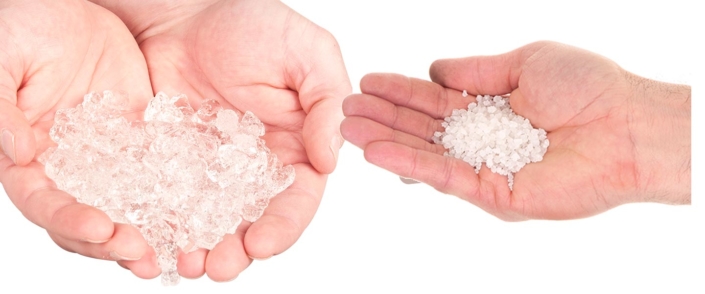
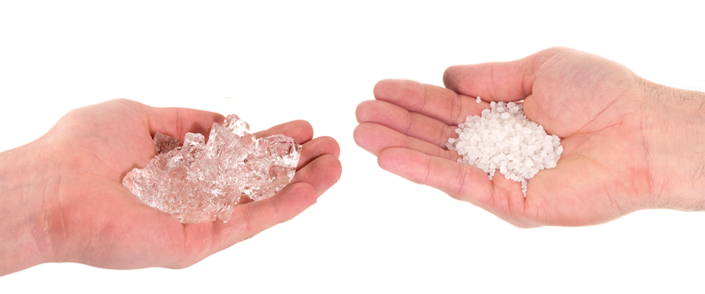
  4. Carefully remove the stuffing from the bag and check out the dry polymer you just extracted from the diaper. 
  5. Pour the polymer into a plastic cup and fill the cup with water. Mix it with your finger until the mixture begins to thicken.
  6. Observe the gel that the polymer and water create. Turn the cup upside-down and see how it has solidified. Take it out and play with it. Amazing stuff!
  7. Put the pieces of gel back into the cup and smoosh them down with your fingers. Add a teaspoon of salt, stir it with a spoon and watch what happens. Salt messes up the gel's water-holding abilities. When you're finished, pour the salt water goo down the drain.
  8. Grab a new diaper and slowly pour about 1/4 cup of warm tap water into the center of the diaper. Hold the diaper over a large pan or sink and continue to add water, a little at a time, until it will hold no more. Keep track of how much water the diaper can absorb before it begins to leak.

How Does It Work?

The secret water-absorbing chemical in a diaper is a superabsorbent polymer called sodium polyacrylate. A polymer is simply a long chain of repeating molecules. If the prefix "poly" means many, then a polymer is a large molecule made up of many smaller units, called monomers, which are joined together. Some polymers are made up of millions of monomers.

Superabsorbent polymers expand tremendously when they come in contact with water because water is drawn into and held by the molecules of the polymer. They act like giant sponges. Some can soak up as much as 800 times their weight in water! That would be one wet baby!

The cotton-like fibers you removed from the diaper help to spread out both the polymer and the, uh, "water" so that baby doesn't have to sit on a gooshy lump of water-filled gel. It's easy to see that even a little bit of powder will hold a huge quantity of water, but it does have its limits. At some point, baby will certainly let you know that the gel is full and it's time for new undies!

In spite of their usefulness, these diapers can be a problem. If you've ever observed a baby in diapers splashing in a wading pool, you know that even one diaper can absorb lots and lots of water. Most public pools won't allow them to be worn in the water because huge globs of gooey gel can leak out and make a mess of the filter system. Also, some folks used to throw them away in toilets - not a good idea unless you're a plumber. For the most part, however, these diapers are a great invention and make for dry, happy babies.

Additional Info

Science Fair Connection:

A good science fair project changes something, creates a new experiment, and compares the results. 

  • Change the brand of diaper and, using the steps listed above, test it to see just how much water it will absorb. Compare your results to the absorbency of the first diaper you tested.

The brand of diaper is the variable in this experiment. Be sure to use the same size of diaper even though you are using different brands. If you test a large Pampers diaper against a newborn-sized Huggies diaper, your results will not be reliable. Everything needs to stay the same except for the brand of diaper. You'll find out extremely quickly if you get what you pay for or if there really isn't a difference between the brands. Document your discoveries and share them at the science fair. Many moms with young children will thank you for your research!

Customer Reviews

Maybe depends on the brand? Review by June
43211

I did a test before doing this with my class- using a home brand from Australia.
I got lots of quite hard fluff from the centre and no crystals shaking out. I shredded the fluff and still no separate crystals.
I then added water straight to the lot in the bag- wow! Most of it was crystals! They must be teeny tiny. Hardly any cotton at all!
I will try other brands 1st, but the kids would still enjoy adding water to the bags to see and feel the polymers, and could measure how much water they absorb.

(Posted on December 18, 2011)

WIN Review by Julio Martinez
54321

My son won the science fair with this experiment and it is great.

(Posted on September 26, 2012)

Worked for us Review by Carolyn L.
54321

Our class did a science fair project using the baby diaper idea. We chose 3 different diapers; a high priced brand, a mid priced brand and an economy brand. We did three trials with each diaper. The polymers absorbed the water. The kids loved it.

(Posted on February 19, 2013)

Diaper Experiment Review by Rebecca Tinucci
14321

I bought two different types of diapers. I end up with a sticky soupy mess everytime. The polymers don't join to make a ball of slime. It would never stay in the cup to put over someones head. I was disappointed because I was going to add this to my son's Steve Spangler birthday! We love everything else we ordered.

(Posted on August 26, 2010)

Baby Diaper Secret Review by B Towers
54321

I did this with my first grade students and they were fascinated by the amount of water the crystals could hold. I did buy the cheaper brand and it was full of crystals.
We added water a little bit at a time to see the effects and watch the amount in the glass grow. Once we were done, I placed the crystals on black construction paper and let the students feel it. I then put more crystals on the construction paper and poured water on it. They absorbed the color of the construction paper. We called it fake snow and the darker crystals were fake dirty snow. They loved it.
We later had fun with more of the same adding food coloring to see the change as we added water.

(Posted on January 11, 2013)

Works good when the water to polymer ratio is correct. Review by Anna
54321

If you are getting sludge, you have added too much water!

(Posted on December 10, 2011)

Fail Review by KC
14321

This experiment does not work as advertised. The water turns into a soupy state and is not entirely solid. It is definitely not solid enough to turn upside down and put on someone's head.

(Posted on July 10, 2011)

Write Your Own Review


You're reviewing: Baby Diaper Secret


How do you rate this experiment? *
1 star 2 stars 3 stars 4 stars 5 stars